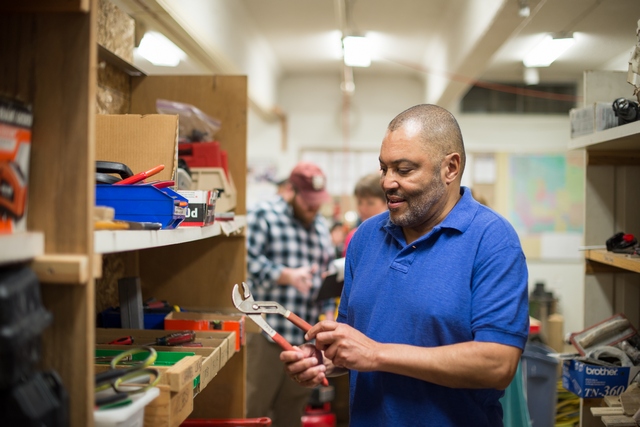

New Tools at the Tool Library

We are excited to add a variety of new tools that our members have been asking for.  A portion of the money we raised from the Give!Guide was used to purchase these high quality tools.  Many of the new  tools described below are factory reconditioned and almost new:


DeWALT 4-1/2-Inch Small Angle Grinder

This grinder is great for sanding and grinding high spots in concrete or cutting steel bolts. This is a nice heavy duty tool to add to our collection.


Bostitch Compressor and 18-Gauge Brad Nailer

With all the pneumatic tools in the Tool Library, we decide to purchase an air compressor. This is an oil-free compressor and good for all of your around-the-house projects.  The 18-Gauge Brad Nailer takes up to 2” nails and is great for adding all that trim work in your house.


Heavy Duty 1240w Electric Demolition Jack Hammer

Because of the popularity of this tool, we now have two jack hammers.  This is an awesome tool for removing old concrete slabs and pathways with ease.  It is also fairly lightweight and easier to handle compared to most jackhammers found at rental stores.

The most important thing to remember when using this tool is to keep the oil level filled to maintain proper lubrication. We also have an extra set of chisels to use with the jack hammer, since they do wear out with use.


Pneumatic Palm Nailer

A palm nailer is useful for nailing joist hangers on a deck, framing walls in your house, or nailing in awkward spaces. The nailer connects to an air compressor and fits comfortably in the palm of your hand. It functions like a regular hammer by driving a nail into the wood with a piston that moves back and forth.  It is intended for rough nailing and not finish work.


1-Inch Bosch Rotary Hammer

This heavy-duty rotary hammer is very capable for all normal homebuilding or remodeling tasks. It will drill holes fast and install anchors in concrete or masonry in a few seconds. It drills into most concrete as if it is drilling into butter, which can save you hours of labor.

A hammer drill works a lot like a regular power drill; with one extremely important feature.  Instead of spinning a drill bit, a hammer drill also creates a percussion effect that rapidly hammers a bit into the material at a rate of thousands of blows per minute. The spinning action draws waste material out of the hole. While it is a simple little feature, the percussion effect is what allows a user to easily drill hole after hole into common masonry, rock, and concrete. As an added bonus, you can also simply turn off the percussion and use a hammer drill on wood, drywall, and other less dense materials, just as you would use a normal power drill.

Please stop by the tool library if you have any questions on how and when to use any of these tools.  We are always happy to help you find the right tool for the right job.

Posted in Tools | 2 Comments

Tool Library Helps Build Skills at Rigler School

January 20th – NEPTL was invited to participate in Build It! at Rigler School. Students and their parents had a chance to tackle hands-on activities like using hand tools and building structures from common household materials such as popsicle sticks or uncooked spaghetti.

Rigler is a K-8 public school located at 5401 Northeast Prescott that focuses on language learning, including a 2-way Spanish immersion program. Rigler’s 600 students come from varied cultural and language backgrounds, with about a third of the students speaking a first language other than English, including Spanish, Vietnamese, and Somali.

NEPTL volunteers helped excited kids hammer nails and drive screws into a ten-foot 6×6, donated for the event by Parr Lumber. For many, this was the first time they had ever used hand tools.

At the hammering station, NEPTL volunteers provided a row of ready-to-pound nails for kids to test their skills. A pair of young brothers in safety glasses competed to see who could sink a nail first. They quickly discovered the delicate balance between power and accuracy, adjusting their grip as they tried to outpace each other.

Estefani and her friend Aracelie were among those who lined up to use screwdrivers to muscle drywall screws into the massive beam. After considerable effort, Estefani drove a screw almost flush and then paused. With a glimmer of recognition, she declared that she could probably use a screw at home to hold up a picture. To complete the task, she grabbed a pen and proudly signed her name next to the slightly protruding fastener. Nearby, Aracelie confidently turned her own screw into the wood while explaining that she and her dad built a doghouse together over the summer.

The event was part of an ongoing effort at the school to involve parents more in their kids’ learning and to foster the underlying supports that students need to succeed. Rigler staff planned Build It! to draw the interest of both moms and dads. “It’s often just the moms” who get involved, said teacher Mari Bartoo Jacobson. From across the gym she watched groups of kids and parents go from one activity station to the next, with dads significantly outnumbering moms.

At one table Cynthia Bui and her dad Dong were putting the finishing touches on a 12-inch long bridge made from popsicle sticks and duct tape. Cynthia, who studies Spanish at Rigler and speaks Vietnamese at home, explained the goal: make a bridge that could hold the most weight using only a small supply of sticks and tape. As she worked, Cynthia spoke to her dad in Vietnamese then explained that he had helped figure out that a triangle would make a stronger structure and would also use fewer sticks. Attaching the last piece of tape, she hurried off to another table to put her structure to the test.

Build It! helped spread the word about an upcoming school facilities bond measure that would renovate or rebuild aging Portland schools, including Rigler. After helping his son build a bridge, Anthony Lincoln spoke to parents about Measure 26-121, describing the need for a modern building to replace the 1931 structure. He lamented the current school’s leaky plumbing, antiquated heating system, and portable classrooms, and urged support for the measure. At a nearby table kids drew their own visions of what the new school might look like… roller-coasters and all.

Tom Thompson, NEPTL volunteer and Tool Master, enjoyed teaching the students about basic tools. “Half of them said they’d never hammered a nail before!” He felt the event was a success for the library, too, as he handed out NEPTL brochures to interested parents.

School counselor Nicole Levine expressed gratitude for NEPTL’s involvement and hoped it would help raise awareness among parents about the valuable community resource provided by the tool library, adding, “We’d love to see more families join.”

Posted in Events | 1 Comment

Drywall Repair: How to Patch Ceilings and Walls

The method to use for drywall repairs and patching depends on whether the damage is on a wall or the ceiling. Each repair poses both unique and similar challenges. The wall repairs are best done first, if possible, then the ceiling since they tend to be more involved; don’t be caught on a ladder wondering what to do next without a grasp on the basics, it’s not the time for guesswork. You should first develop the techniques for mudding and taping, basic cuts and hole patches before you tackle more involved projects.

Mudding and Taping

The types of joint compounds are unique in the properties they offer. From hot mud (speed dry) to all-purpose and then for final coating, topping mix. Hot mud will set the cut patch in place and requires taping, which accelerates dry time and makes the repair go quicker. The speed dry mud comes in bagged, powdered form. But it is not intended for final coating. It is mainly used for bedding, curing to the hardest granular set.

Redi-mix, multi-purpose is a bedding and finish compound. When sanding, redi-mix topping compound is ideal. Certain multi-purpose mixes are formulated to shed toward the ground upon sanding, rather than dissipate into the air.

Wall Hole Repair

Damage to the walls can be caused by moving, by all sorts of accidents or even vandalism. When repairing holes in the wallboard, there are a variety of techniques that can be applied across damaged areas as determined by hole size. For dings and surface repairs there is wall spackling.

Walls that have roughly pencil-sized hole damage are prevalent from mounts and brackets inserted into the drywall. These small holes in the wall can be entirely restored to the eye. Damage of the next approximate increment – hole repairs up to a couple inches across – starts to require taping to prevent cracking and to form structural basis for the compound. This is an important concept for all repairs, mudding and taping.

Board swapping, or replacing the existing with new drywall sections, is the sturdiest fix overall. It provides both the most serviceable surface and amount of deterrence to cracking as compared to other techniques. The materials you have on hand and the extent you wish to go to, to secure a strong patch, will make all the difference – with hole size remaining a significant factor.

The advent of metal patching methods provides another choice for repairing sizable damage.

Ceiling Area Repairs

Damage to ceilings can be caused by everything from roof leaks to a misplaced foot when walking in the attic. Almost all the skills you have learned from wall repair is applicable to ceilings as well.  Keep in mind though that joint compound is notorious for sagging when repairing ceilings. Larger braced ceiling repairs offer durability as do smaller replacements with clips; it’s all a matter of choosing the best method for the repair that is before you.

For all patches both ceiling and walls, where there is the element of direct physical wear, like with the changing out bulbs with canned lighting or the constant light force of a hand onto a wall plate, some methods like a mesh tape patch alone for a section of mis-cut drywall — might possibly crack out. Therefore the amount of wear is a factor in deciding which patch method is best suited.

As you can see, there is a lot to know about drywall.  This is just the tip of the iceberg. You can read more about drywall repair online at http://drywalltips.org/ or your favorite home improvement website.  When you’re ready to get started, drop by the tool library for your supplies.

Posted in Resources | 1 Comment